
William Bridges had been grappling with many changes in his own life. Through a series of workshops and conversations with ordinary people facing all kinds of life transitions, he began to notice common patterns in how people responded to change.
These observations eventually led to his book Transitions, first published in 1980. More than 40 years later, it is still regarded as one of the most influential books ever written on navigating life’s changes.
Bridges makes an important distinction between change and transition.
Change is the external event: a new job, a promotion, retirement, a relationship ending, moving house, becoming a parent or completing a major qualification.
Transition is the inner psychological process we go through as we come to terms with that change.
His model is simple. He suggests that most significant life transitions involve three overlapping phases:
- Endings
- Neutral Zone
- New Beginnings
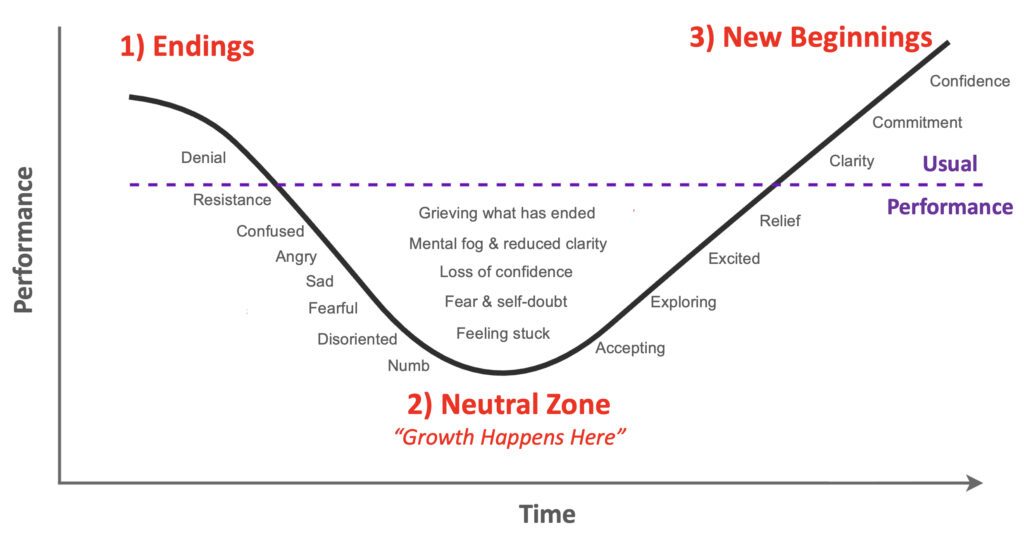
Adapted from William Bridges’ Transition Model
What fascinates me the most in his model is the Neutral Zone. Personally, I would describe it as life’s washing machine.
Imagine being inside a washing machine that has just started its cycle. It is noisy, uncomfortable and disorientating. Things are being thrown around. And if someone has accidentally put a bright red sock into the load, you have absolutely no idea what colour you will come out at the end.
That, in essence, is what Bridges means by transition.
Something is happening to us, but we do not yet know what the outcome will be. The old version of ourselves is fading away while the new one has not yet emerged.
And that uncertainty is precisely what makes the Neutral Zone of any transition so uncomfortable.
What struck me when reading Bridges is that this does not only apply to difficult or painful events.
A promotion, marriage, becoming a parent, retirement or completing a major qualification can all throw us into the washing machine. Although these look like positive events, they still require us to let go of old identities before stepping into the next chapter.
Bridges identified five experiences that often accompany the process of letting go and entering the Neutral Zone. Becoming aware of these five D’s can help us understand what is happening and navigate this difficult phase with more compassion and patience.
- Disengagement: We pull away from old routines, relationships or ways of operating. We may need more time alone. We may temporarily withdraw. This is often a natural part of the process, rather than something to resist.
- Dismantling: With a little distance, we begin to take apart the old chapter. We look more objectively at what was and start to see both its strengths and limitations.
- Disenchantment: We gradually realise that the old way of doing things no longer fully serves us. The spell begins to break. What once felt right may no longer fit so well.
- Dis-identification: Perhaps the most difficult step. We begin letting go of the roles, titles and identities that previously defined us. The question “Who am I now?” can become surprisingly unsettling.
- Disorientation: As the old falls away and before the new has fully arrived, it is natural to feel lost, uncertain or confused. We are standing on the shoreline of the past looking out into unfamiliar waters.
Seen through Bridges’ model, these experiences are not signs that something has gone wrong. They are signs that transition is taking place. Feeling unsettled, questioning ourselves, withdrawing for a while or not yet knowing what comes next is often part of preparing for a new beginning.
Recognising these five D’s doesn’t necessarily make the washing machine stop spinning, but it can reassure us that what we are experiencing is a normal part of the journey.
And perhaps that understanding allows us to stay with the process long enough for something new to emerge.
If you, or someone close to you, is currently going through a period that feels confusing, emotional, slow or strangely unproductive, it may be worth asking: Am I simply in the Neutral Zone?
If the answer is yes, perhaps the task is not to force clarity or rush towards the next chapter.
Instead, acknowledge what has ended, be patient with yourself and allow yourself to spend some time in the washing machine.
There may even be moments when you feel tempted to run back to what is familiar simply to escape the discomfort. If you can, resist that temptation. Tiny steps forward are enough. You don’t have to see the whole path … just the next step.
Talk to trusted friends. Seek support if needed. Above all, be kind to yourself. The Neutral Zone rarely feels comfortable, but it is often where the deepest growth takes place.
At some point, the washing cycle finishes.
And although you may not come out exactly as you went in, you may discover that the person who emerges is precisely the person needed for the next beginning.
Happy washing. 😊
Joerg

Leave a Reply