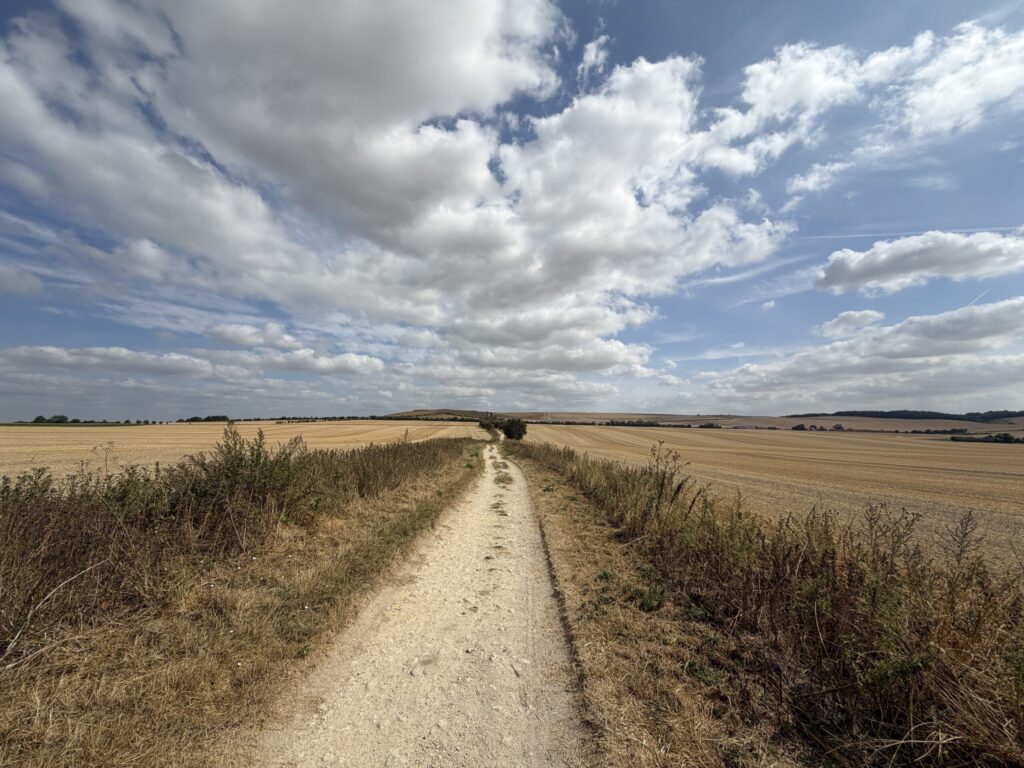
At the end of August, I took six days out just for myself. Having walked the South Downs Way in 2025, I had set my sights on the Ridgeway, considered Britain’s oldest road and travelled by people for more than 5,000 years.
Full of enthusiasm, I started out from the famous stone circle at Avebury … 160 kilometres through wide-open countryside, mostly on my own.
I loved the solitude. No meetings. No emails. No distractions. Just putting one foot in front of the other. And somewhere along the way, I began learning a lesson that wouldn’t fully reveal itself until much later …
The Ridgeway isn’t technically a difficult trail. But 27 kilometres for six consecutive days, combined with its remoteness, made it harder than I had expected. The first café directly on the trail came after almost 90 kilometres!
When things got tough, I noticed an interesting little piece of head-cinema going on inside myself:
Head: Come on, pull yourself together! You’ve done much harder things. You set yourself a target, so you finish it. On the Camino, you walked for 26 days averaging 30 km. Slowing down isn’t an option!
Body: One step at a time. Slower. Another break would be good. Time for some water and a snack. No big dinner tonight, just some rest and sleep.
This time I listened to my body more than I might have done in the past. Six days later, I arrived at Ivinghoe Beacon. But the real lesson came a week later, reflecting on the walk with Ludwig in a Welsh forest.
“It was beautiful,” I told him. “And hard.” Ludwig stopped me: “Why was it hard?”
An annoyingly good question. 😄
Nobody had forced me to walk 27 kilometres a day. I could have walked 20. Taken longer breaks. Had a day off. Called a taxi. Sat under a tree for two hours. So where did the hardness come from?
As we explored the question, I recognised an old and familiar character: my inner loyal soldier — a concept beautifully described by Bill Plotkin and later Richard Rohr.
My loyal soldier shouted: Finish what you started! Deliver! Don’t disappoint! Prove yourself!
That soldier has taken me a very long way. But perhaps he doesn’t need to be on duty 24/7?
This reminded us of the remarkable story of Japanese Lieutenant Hiroo Onoda.
At the end of World War II, Onoda was stationed on Lubang Island in the Philippines. Refusing to believe Japan had surrendered he continued his mission for almost 29 years. Even leaflets announcing the end of the war failed to convince him. He believed them to be enemy propaganda.
When a young Japanese adventurer finally found him in 1974, Onoda insisted he would only stand down if his former commanding officer relieved him of duty. So Japan tracked down Major Yoshimi Taniguchi … by then a bookseller … and brought him to the Philippines. Only after Taniguchi formally relieved him of his duties did Onoda’s war end and he could finally return home.
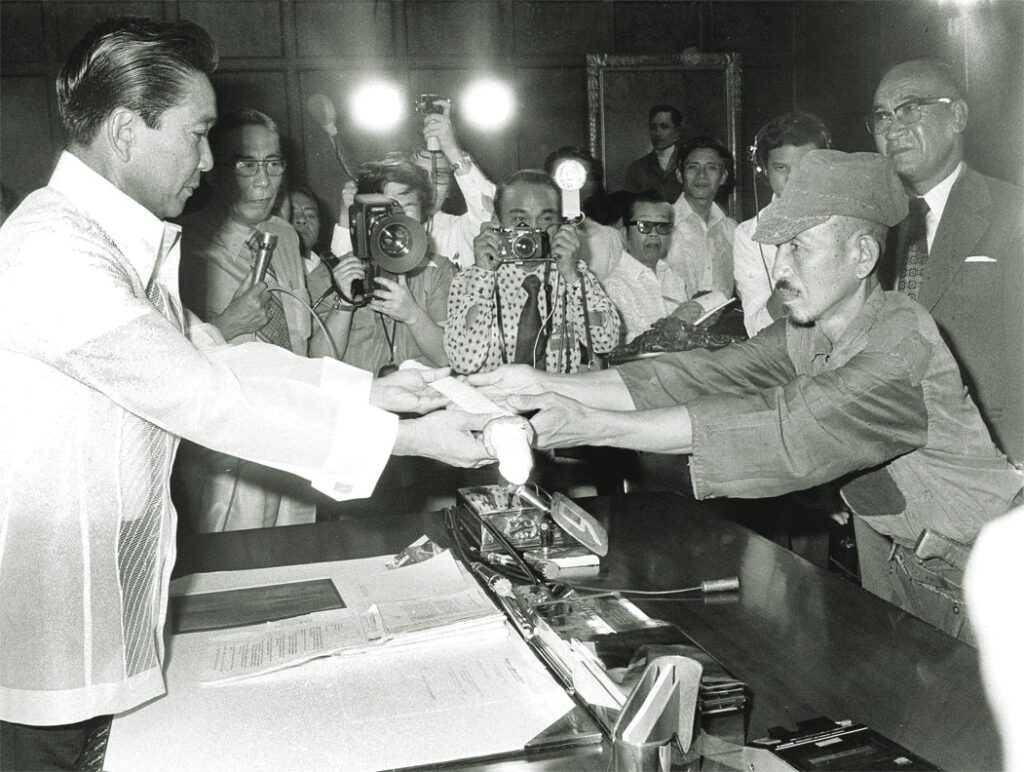
Photo by By Malacañang Palace – http://www.gov.ph/, Public Domain, https://commons.wikimedia.org/w/index.php?curid=43328893
Through Onoda’s story I realised we can carry loyal soldiers inside ourselves too. They are not necessarily bad. Quite the opposite. They may have helped us succeed, belong, stay safe or get through difficult times.
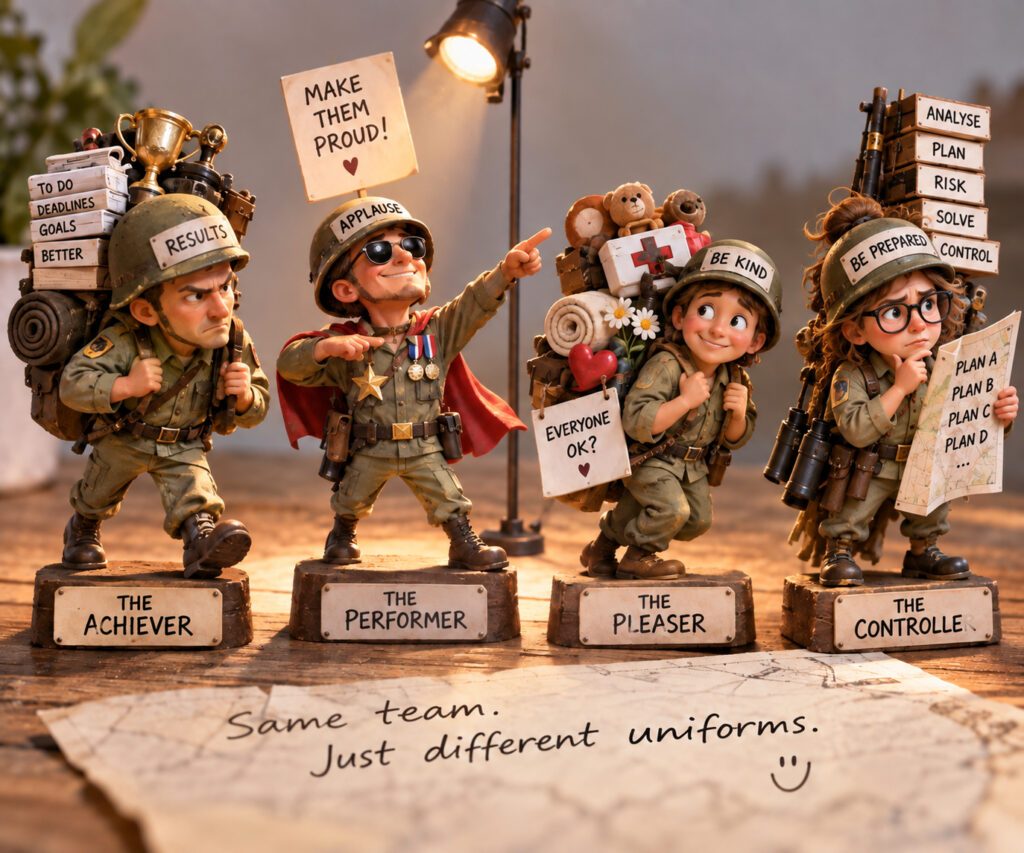
I can see various “soldier uniforms” in my coaching practice — and inside myself (see title image). We may even wear several of them at once. Perhaps you recognise some:
- The Achiever: “Work hard. Get it right. Don’t disappoint.” Once a powerful route to success; now it can make it difficult to ask: What do I REALLY want?
- The Performer: “Make them proud. Show them what you can do.” Recognition once created safety and belonging; now simply being enough can feel strangely uncomfortable.
- The Pleaser: “Understand others. Keep the peace. Don’t upset anyone.” Empathy and diplomacy may have served us beautifully, until our own needs disappear from the conversation.
- The Controller: “Think it through. Be responsible. Don’t make a mistake.” An excellent protector when problems can be solved, but exhausting when life asks us to live with uncertainty.
During the years after the war had ended, people were still hurt and sadly even killed by Onoda. There were real consequences to continuing to fight a war that no longer existed. Our psychological loyal soldiers can cause damage too.
But that doesn’t make these soldiers our enemies. They have protected us, helped us succeed or simply got us through difficult times. Perhaps we can be grateful for everything they have done for us, while also asking: Is their old mission still necessary? Do they really need to stand guard all the time?
Maybe we can discharge them or perhaps just put them on part-time duty. 😄
Because maybe our loyal soldiers don’t need to disappear.
Maybe they just need a tweaked job description.
What do you think?

Leave a Reply