
Last week, I met up with my fellow coach and good friend Tom (name changed for confidentiality). Several years ago, I had attended a mindfulness training for coaches that Tom was facilitating. We stayed in touch, and over time became good friends, regularly sharing the ups and downs of coaching and what was going on in each other’s lives.
Tom told me about a challenging situation in his business.
Over the past months, the coaching platform that had generated most of his income had significantly reduced the number of coaching engagements. The reason? They had begun integrating AI coaching tools, and fewer human coaches were needed.
Given the potential impact on his revenue, I would have expected Tom to be worried or even panicking. But it was almost the opposite. He was calm and composed. He even seemed a little happier than usual. Curious, I asked what had happened.
His response contained a powerful lesson.
Tom, being a very calm and observant person, had somehow seen the change coming. For several months he had noticed some signals in the platform’s communication and realised that a shift was inevitable.
So, several months ago, he had decided to take action.
First, he began working toward the highest coaching certification with the International Coaching Federation … the Master Certified Coach (MCC). Thanks to this early decision, he is now already close to completing it.
Second, he decided to use the very technology that had reduced his coaching work … AI … to his advantage.

He analysed hundreds of his previous coaching sessions and used AI to identify patterns such as:
- With which clients did he do his best work?
- Which topics created the most impact?
- What types of clients did he enjoy working with most?
This powerful data now forms the foundation of a new positioning strategy he is developing together with a marketing coach.
Tom was smiling as he told me about it. He said it feels like an exciting new chapter.
I immediately thought to myself, if something like this happened to me … losing a large part of my revenue … I might panic or freeze, rather than move on as decisively as Tom did.
So, we talked about what had helped him respond this way, and it turns out there was one magical ingredient he identified early in the process.
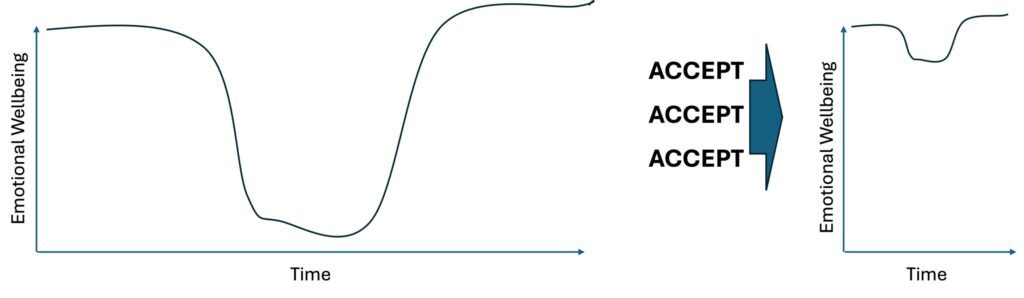
To explain, let me briefly refer to the change curve inspired by the work of Elisabeth Kübler-Ross regarding the stages of grief. Although this model was initially developed for grieving processes, it can also be applied to many change processes we experience in life, because every change involves some form of loss.
Most of us recognise that when we experience loss, we often move through phases … denial, frustration, bargaining, sadness, experimentation … and moving on. These stages are rarely linear. We may move back and forth between them and sometimes experience several at the same time, but I want to highlight the 2 dimensions of the change curve here:
- Horizontal axis: Time (how long we stay in the valley of change)
- Vertical axis: Emotional Wellbeing (how low we dip during the change)
And this is where Tom’s magical ingredient made the difference.
Very early in the process, he did something simple but very powerful.
He accepted the situation.
Once he had accepted the problem existed, he didn’t spend much time bargaining or resisting reality. He moved into action mode. As a result, the time spent in the valley became shorter and the emotional depth of the valley much shallower.
Instead of fighting reality, he started acting quickly, focusing on what was still within his control.
Speaking with Tom about this, I was reminded of the lesson from a Buddhist monk I met during a Vipassana retreat in Northern Thailand. He shared with us three simple words that are the key to achieving mindfulness … words that contain tremendous wisdom:
ACCEPT. ACCEPT. ACCEPT.
Acceptance is not resignation. It simply means acknowledging reality as it is, rather than denying it, so we can start responding to it. When we resist reality, we stay stuck. When we accept it, we regain our agency and can shorten the time and reduce the depth of the change curve.
In other words, we significantly soften the “bumps in the road” of change.
So, here is a small reflection for you today:
Is there a situation in your life right now that is weighing on you?
Something you might still be bargaining with or resisting?
What would happen if you first simply accepted that the situation exists?
Not because it is easy. But because acceptance may be the fastest way through change, often with much less distress.

Leave a Reply